
How AI Is Changing Meeting Rooms and Workplace Collaboration
Updated: Jul 24
Few technologies have captured the imagination of the business world quite like Artificial Intelligence.
In boardrooms, strategy sessions and industry conferences, conversations about AI are now almost impossible to avoid. Organisations across every sector are exploring how it might improve productivity, automate routine tasks and create competitive advantage. New tools appear almost daily, each promising to transform the way we work.
Yet beneath the headlines and excitement, a quieter transformation is taking place.
It is happening in meeting rooms.
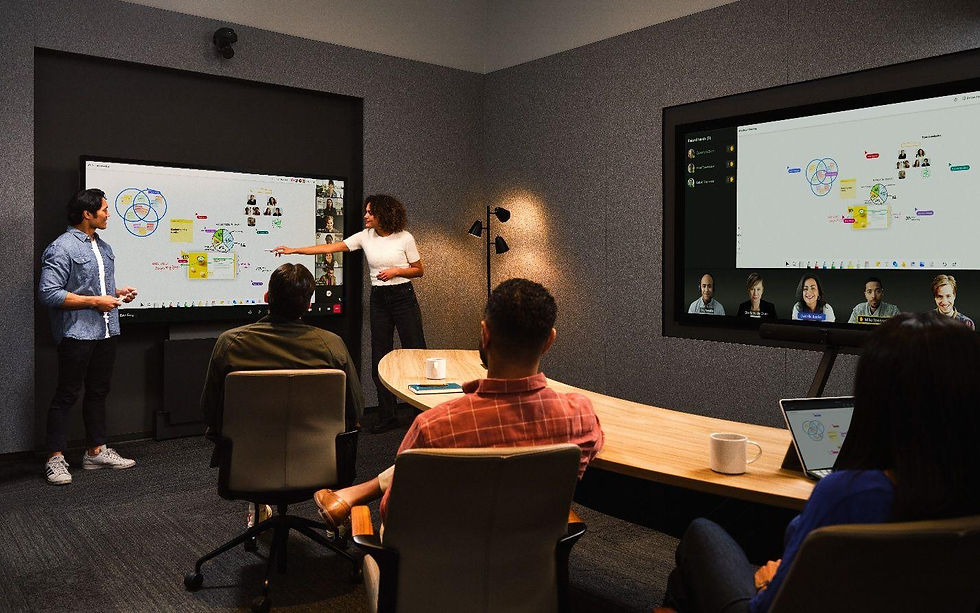
At first glance, this may seem like an unlikely place for meaningful innovation. Meeting rooms are not typically associated with technological breakthroughs. They are familiar spaces where teams gather, discussions take place and decisions are made. For many organisations, they have looked broadly similar for years.
But perhaps that is exactly why the changes now underway are so significant.
Because meeting rooms sit at the heart of how organisations collaborate. They are where ideas are shared, strategies are developed and relationships are strengthened. If AI can improve the quality of those interactions, its impact could extend far beyond technology itself.
The interesting thing is that AI is not simply introducing new features into workplace collaboration. It is beginning to challenge some of the assumptions that have shaped workplace technology for decades.
Historically, technology has required people to adapt.
Every new system introduced new processes. Every new platform required training. Every new collaboration tool came with a learning curve. Organisations invested heavily in adoption programmes because successful technology deployment depended largely upon users changing their behaviours.
This was accepted as normal.
If you wanted the benefits of technology, you learned how to use it.
Artificial Intelligence is beginning to reverse that relationship.
Increasingly, workplace technology is becoming capable of understanding context, interpreting behaviour and responding dynamically to the needs of users. Rather than expecting employees to conform to technology, technology is starting to adapt to employees.
That may prove to be one of the most important workplace shifts of the next decade.
Because if we examine many of the frustrations that have traditionally existed within workplace collaboration, they were never really technology problems in the first place.
They were human problems.
Most organisations are familiar with them.
Meetings that begin several minutes late because participants are struggling to connect.
Discussions where remote attendees feel less engaged than those sitting in the room.
Important actions that are forgotten because nobody captured them effectively. Valuable ideas that disappear into lengthy conversations and become difficult to revisit later.
The technology supporting those meetings has improved enormously over the years. Video conferencing platforms are more capable. Audio quality is better. Cameras are smarter.
Connectivity is more reliable.
And yet many organisations still experience the same underlying frustrations.
The reason is simple.
Technology has traditionally focused on enabling communication.
The next generation of AI-powered collaboration tools is increasingly focused on improving communication.
That distinction matters.

At this year's InfoComm exhibition, one of the dominant themes emerging from Microsoft and its ecosystem partners was not simply the addition of AI capabilities. It was the idea of creating more intelligent, inclusive and responsive workplace experiences. Microsoft's announcements around Teams Rooms reflected a growing emphasis on AI-driven room intelligence, enhanced meeting equity and tools designed to help organisations manage spaces more effectively while reducing the burden on both users and IT teams.
What is particularly interesting is how many of these developments are focused on reducing friction.
For years, meeting room technology has largely been reactive. Users entered a room, started a meeting and interacted directly with the technology throughout the session. If something went wrong, people were responsible for resolving it.
Increasingly, AI is enabling technology to become more proactive.
Meeting rooms can automatically frame participants. Audio systems can distinguish between voices and background noise. Collaboration platforms can generate summaries, capture actions and make conversations searchable. AI assistants are beginning to support room administrators with insights and management recommendations that previously required significant manual effort.
Individually, these developments may seem relatively modest.
Collectively, they represent something more profound.
The meeting room is gradually evolving from a collection of devices into an intelligent environment.
Perhaps nowhere is this more important than in the context of hybrid working.
The rise of hybrid work exposed a challenge that had existed for years but was often overlooked. Not everybody experiences meetings in the same way.
Those physically present benefit from natural conversational cues, body language and informal interactions that help discussions flow. Remote participants often rely entirely on what the camera sees and what the microphone captures. Even in well-equipped spaces, the experience can feel different.
This creates what many organisations now recognise as a meeting equity challenge.
How do you ensure that everybody has an equal opportunity to contribute regardless of location?
Technology alone cannot solve this issue.
Good meeting culture, effective leadership and thoughtful facilitation will always matter.

However, AI is beginning to provide tools that can help narrow the gap. Intelligent camera systems can provide better visibility of speakers. Advanced audio processing can improve clarity. Real-time transcription and translation can improve accessibility. Meeting summaries can ensure that important information remains visible to everyone rather than only those who happened to be in the room. Microsoft's continued investment in these capabilities reflects a broader industry recognition that workplace collaboration must become more inclusive if hybrid working is to succeed long term.
What fascinates me most, however, is that the most valuable AI in the workplace may ultimately be the AI that employees barely notice.
Whenever a new technology emerges, there is a natural tendency to focus on its most visible capabilities. The demonstrations, the headline features and the moments that create excitement.
Yet history suggests that the technologies with the greatest long-term impact are often those that quietly become part of everyday life.
We no longer think about email as innovative.
We rarely think about Wi-Fi.
Most employees give little thought to cloud computing.
These technologies became valuable because they disappeared into the background.
The same may ultimately prove true of AI.
Its greatest contribution may not be generating content or answering questions.
It may be removing the countless small frustrations that have historically disrupted workplace collaboration.
The AI that ensures everyone can hear clearly.
The AI that captures decisions automatically.
The AI that helps remote participants feel equally involved.
The AI that quietly removes obstacles before users even notice them.
If that future sounds less dramatic than some of the predictions surrounding Artificial Intelligence, it may also be considerably more valuable.
Because the purpose of workplace technology has never really been to impress people.
Its purpose is to help people do their best work.
This is where organisations should remain thoughtful.
As with every major technological shift, there is a temptation to pursue innovation simply because it is available. New features appear. New capabilities emerge. Vendors race to showcase the latest advancements.
The most successful organisations, however, are rarely those that adopt technology first.
They are the organisations that understand why they are adopting it.
The most important question is not what AI can do.
It is what business problem needs solving.
Sometimes the answer will involve AI.
Sometimes it will involve workplace design, meeting culture or collaboration strategy.
More often than not, it will involve a combination of all three.

At COLLAB AV, we believe this is where the conversation should begin. Not with products, features or specifications, but with people. Understanding how teams communicate, where collaboration breaks down and what experiences employees are having today remains far more important than chasing the latest trend.
The organisations that derive the greatest value from AI over the coming years are unlikely to be those with the most sophisticated technology.
They will be the organisations that use technology to create simpler, more inclusive and more intuitive experiences.
Because ultimately, workplace collaboration has never been about cameras, displays or software platforms.
It has always been about people sharing ideas, making decisions and moving organisations forward together.
If Artificial Intelligence can help make that process easier, more natural and less frustrating, then its greatest achievement may not be technological at all.
It may simply be helping people collaborate better.


Comments