
Hybrid Meetings Shouldn't Feel This Difficult
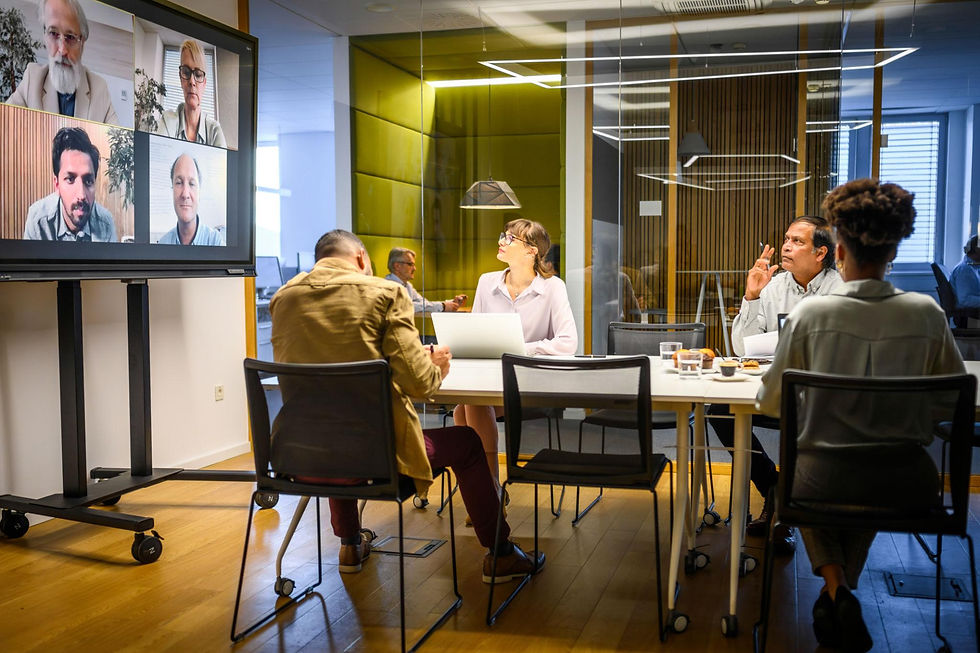
For many organisations, hybrid working has become so deeply embedded within everyday business life that it is difficult to remember a time when meetings happened any other way. Employees move between home offices, customer sites and company workplaces with increasing fluidity. Teams collaborate across multiple locations, often without giving much thought to the technology enabling those interactions. What was once considered a temporary adjustment has evolved into a permanent feature of modern working.
Yet despite this transformation, there remains an uncomfortable truth that many businesses rarely stop to examine.
Hybrid meetings are often far more difficult than they should be.
Not because the technology is unavailable. Not because organisations have failed to invest. In fact, quite the opposite. Businesses across the UK have spent significant sums equipping meeting rooms, deploying collaboration platforms and supporting flexible working arrangements. The technology itself has improved dramatically. Cameras are more intelligent, audio systems are more capable and collaboration platforms continue to introduce increasingly sophisticated functionality.
And yet, despite all of this progress, many employees still leave meetings feeling frustrated.
The reasons are often subtle. A discussion begins before remote participants have joined. Somebody in the room makes a comment that those online struggle to hear. A screen-sharing issue delays the start of the meeting. A remote colleague hesitates to contribute because they are unsure whether it is the right moment to speak. None of these issues appear particularly significant in isolation, but together they reveal something important.
Many organisations have successfully enabled hybrid working without fully mastering hybrid collaboration.

This distinction matters because there is a significant difference between allowing people to work from different locations and creating an environment where those people can collaborate effectively regardless of where they happen to be based.
The workplace technology industry has understandably focused much of its attention on connectivity. For several years, the priority was ensuring that employees could communicate, access information and remain productive while working remotely. In many respects, this challenge was solved remarkably quickly. Businesses adapted at an extraordinary pace and employees demonstrated impressive resilience throughout the transition.
However, while organisations became highly effective at enabling remote access, many never fully redesigned the collaborative experience itself.
Instead, existing meeting habits were transferred into hybrid environments with relatively little consideration for how those environments might fundamentally change the dynamics of communication. Traditional meeting structures remained largely intact. Meeting rooms continued to be designed around those physically present. Processes evolved gradually while workplace expectations changed rapidly.
As a result, many businesses now find themselves operating in a hybrid world using collaboration practices originally designed for a very different era.
Perhaps the most interesting aspect of this challenge is that it is rarely caused by poor intent. Most organisations genuinely want to create inclusive and productive meeting experiences. Employees want colleagues to feel engaged. Managers want participation from all attendees. Leadership teams want technology investments to generate value.
The problem is that hybrid meetings introduce a subtle imbalance that many businesses underestimate.
When some participants are physically present and others are joining remotely, people are no longer experiencing the same meeting. Those sitting around a table benefit from natural conversational cues, body language and informal interactions that occur almost instinctively. They can see who is preparing to speak. They can read reactions. They can engage in the small moments of communication that help conversations flow naturally.
Remote participants often experience something entirely different.
Their understanding of the meeting is mediated through a camera, a microphone and a screen. They rely heavily on audio quality, camera positioning and the behaviours of those within the room. They may struggle to interrupt naturally, contribute spontaneously or participate with the same confidence as those physically present. Even when technology functions perfectly, the experience itself can still feel unequal.
This creates what might be described as an experience gap. Everyone attends the same meeting, but not everyone experiences it in the same way.
Over time, that gap can have meaningful consequences. Employees who consistently feel less connected to discussions often contribute less frequently. Valuable ideas remain unspoken. Engagement gradually declines. Meetings become less effective without anyone being able to identify a single obvious cause.
The irony is that organisations frequently attempt to solve these challenges through additional technology. New cameras are installed. More sophisticated audio systems are deployed. Additional software features are enabled. While these investments can undoubtedly help, they do not always address the root cause of the problem.
Because hybrid meetings are not fundamentally a technology challenge.
They are a collaboration challenge.
Technology plays a critical role in creating the conditions for effective collaboration, but it cannot create collaboration on its own. The most advanced meeting room in the world cannot compensate for poor meeting design, inconsistent behaviours or a lack of consideration for the experience of remote participants.
This is one of the reasons why some organisations achieve excellent collaboration outcomes with relatively straightforward technology while others struggle despite significant investment. The difference often lies not in the equipment itself but in how thoughtfully the entire experience has been designed.
At COLLAB AV, we frequently encounter organisations that initially believe they have a technology problem when, in reality, they have an experience problem.
Employees may complain that meetings feel inefficient. Managers may observe declining engagement. Remote workers may report feeling disconnected from conversations. The immediate assumption is often that a particular platform, device or room configuration is
responsible.
Occasionally that is true.
More often, however, the underlying challenge is that the meeting environment has never been designed around the way people actually work.
This distinction becomes increasingly important as organisations continue to embrace flexible working models. Hybrid working is no longer a temporary solution or an emerging trend. For many businesses, it has become a permanent feature of organisational life. Employees expect flexibility. Customers increasingly embrace virtual engagement. Talent pools are no longer constrained by geography in the same way they once were.
In this environment, collaboration can no longer be treated as something that happens primarily within physical office spaces.
It must function consistently across a variety of locations, workstyles and circumstances.
Achieving this consistency requires organisations to think differently about workplace technology. Rather than focusing solely on functionality, they must consider usability. Rather than asking what technology can do, they must ask how people experience it.
Rather than designing around products, they must design around behaviours.
This is where simplicity becomes particularly important.
There is a common misconception that more features automatically create better collaboration experiences. In reality, complexity often introduces friction. Every additional step, every confusing interface and every moment of uncertainty creates opportunities for meetings to lose momentum.
Employees should not need technical expertise to join a meeting. They should not need to remember complicated processes or navigate multiple interfaces before they can contribute to a conversation. The most successful collaboration environments are often those where technology becomes almost invisible. Participants focus on ideas, decisions and discussions rather than the tools supporting them.
Ironically, creating this simplicity often requires significant expertise behind the scenes.
Seamless experiences rarely happen by accident. They emerge from thoughtful planning, careful design and a deep understanding of how people actually collaborate.
This is why we believe workplace technology conversations should always begin with people rather than products.
Before discussing cameras, displays or platforms, organisations should first understand how their teams communicate, where collaboration breaks down and what frustrations employees are experiencing. Only then can technology be aligned with meaningful business outcomes.
The organisations that will thrive in the years ahead are unlikely to be those with the most technology.

They will be the organisations that create the least friction.
They will be the businesses that make it easy for employees to contribute regardless of location. They will create meeting experiences that feel inclusive, intuitive and consistent.
They will recognise that collaboration is not something technology delivers automatically but something technology should enable effortlessly.
Ultimately, hybrid meetings should not feel like a compromise between remote and in-person working.
They should simply feel like good meetings.
The fact that so many organisations are still striving towards that goal suggests there is work left to do. But it also presents an opportunity. Businesses willing to rethink collaboration through the lens of people, experience and usability rather than products and specifications have the potential to create something genuinely valuable.
Not just better technology.
Better ways of working.
And that is a far more important objective.
At COLLAB AV, we help growing UK businesses create intuitive, people-first collaboration environments that support productive hybrid working. Through consultation, design, implementation and ongoing support, we focus on removing friction so teams can collaborate naturally, effectively and confidently—wherever they happen to be working.


Comments