
Microsoft Teams Rooms vs Zoom Rooms: Or Are SMEs Asking the Wrong Question?
COLLAB AV Insights
Helping growing UK businesses navigate the future of workplace collaboration.
It is one of the first questions many organisations ask when they begin reviewing their meeting room technology.
"Should we choose Microsoft Teams Rooms or Zoom Rooms?"
On the face of it, the question seems entirely logical. Both platforms are recognised leaders within workplace collaboration. Both continue to invest heavily in Artificial Intelligence, hybrid working and meeting room innovation. Both are supported by an impressive ecosystem of certified hardware manufacturers and technology partners. Whether you're creating a single meeting room or designing an entire workplace strategy, it is easy to understand why the conversation often begins here.
Yet whenever we are asked this question, our instinct is rarely to answer it straight away.
Instead, we tend to ask another.
"Why do you believe you need to choose?"
There is usually a brief pause.
Not because it is a difficult question, but because it challenges an assumption that many organisations have never really stopped to examine.
For years, the workplace technology industry has encouraged businesses to think in terms of competing ecosystems. Microsoft versus Zoom. Teams versus Zoom. One platform against another. Vendors naturally promote the strengths of their own solutions, analysts compare features and procurement exercises often become little more than detailed scorecards.
It makes perfect sense.
Except that today's workplace no longer behaves in the way those comparisons assume.
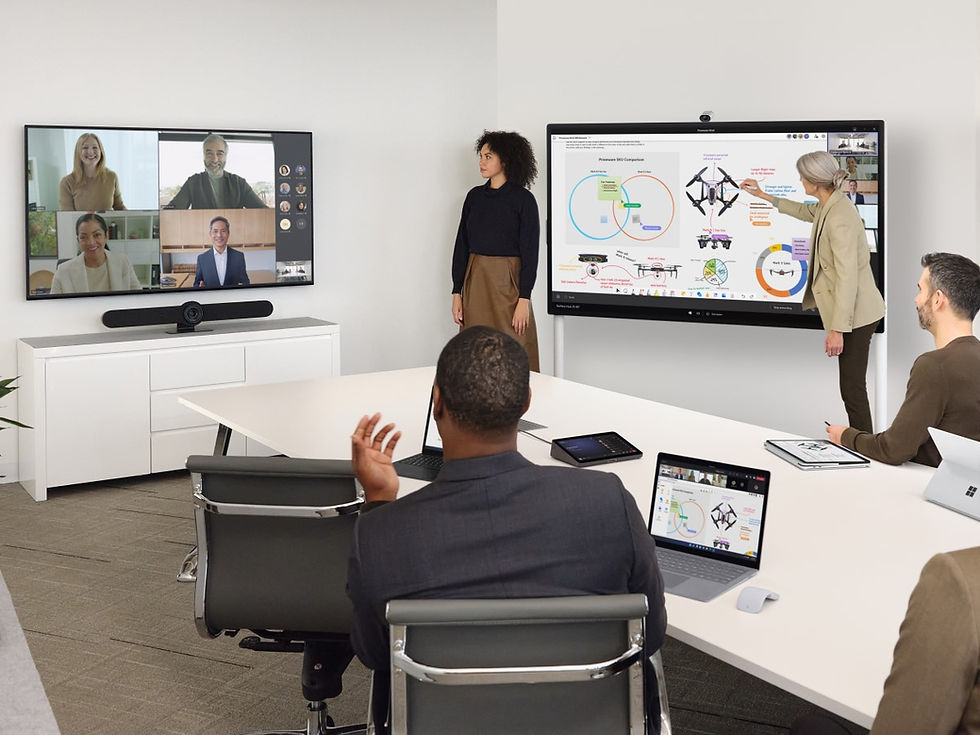
The Modern Workplace No Longer Lives Inside One Platform
Only a few years ago, standardising on a single collaboration platform felt like a sensible long-term strategy.
Employees worked primarily from the office. Meetings were largely internal. Technology environments were easier to control, and organisations understandably wanted consistency across devices, software and support.
Today's reality looks very different.
Most growing businesses collaborate far beyond the boundaries of their own organisation. Sales teams spend their days speaking with prospective customers. Project managers work alongside external consultants. Marketing agencies collaborate with clients using completely different technology stacks. Supply chain partners, legal advisers and third-party specialists all bring their own preferred ways of working.
The meeting invitation arriving in an employee's calendar tomorrow morning may come from Microsoft Teams.
The next one may arrive via Zoom.
The afternoon meeting could be hosted on Google Meet.
By the end of the week, someone may have joined a Webex session without giving the platform a second thought.
In truth, most employees care remarkably little which logo appears on the meeting invitation.
They simply want the meeting to work.
This subtle shift has profound implications for how organisations should think about workplace collaboration.
Perhaps the real challenge is no longer choosing the "best" platform.
Perhaps it is creating environments where collaboration feels effortless regardless of which platform happens to be hosting the meeting.
The Question Behind the Question
This is why we believe the discussion around Microsoft Teams Rooms and Zoom Rooms often starts in the wrong place.
When organisations ask which platform they should install, they are usually trying to
solve a much broader business challenge.
They want meetings to start on time.
They want remote employees to feel included.
They want customers to enjoy a professional experience.
They want technology investments that will remain relevant as their business grows.
They want IT teams spending less time resolving meeting room issues.
And perhaps above all else, they want employees to stop talking about the technology altogether.
These are not platform questions.
They are experience questions.
The distinction matters because experience rarely appears on a specification sheet.
It is created through thoughtful design, intuitive workflows and technology that quietly supports people instead of demanding their attention.
Over the past few years, we have seen countless organisations invest significant sums in workplace technology only to discover that their employees still find meetings frustrating.
The equipment works exactly as intended.
The software has every feature they could reasonably need.
The meeting room looks impressive.
Yet somehow the overall experience still falls short.
Why?
Because collaboration has never been defined by technology alone.
It has always been shaped by the relationship between people, processes and technology working together.
Focusing exclusively on one of those elements almost always leads to disappointment.
Technology Has Changed. Expectations Have Changed Even Faster.
There is another important reason why this conversation deserves fresh thinking.
The pace of change within workplace collaboration has accelerated dramatically.
Five years ago, hybrid working was still viewed by many organisations as an exception rather than the norm. Artificial Intelligence was beginning to emerge within workplace software but had not yet become a strategic priority. Meeting room technology largely focused on improving audio, video and reliability.
Today, the conversation has shifted.
Artificial Intelligence is increasingly becoming embedded within collaboration platforms rather than existing as a separate capability. Meeting rooms are becoming more intelligent, more responsive and more aware of the people using them. Employees expect seamless transitions between home, office and customer locations. Business leaders are no longer simply investing in meeting spaces; they are investing in employee experience.
The result is that choosing a collaboration platform has become far more than a technical procurement exercise.
It is increasingly a strategic decision about how people work together.
Interestingly, this is something both Microsoft and Zoom appear to recognise.
While industry conversations often position the two organisations as fierce competitors, their long-term vision is beginning to converge in some surprising ways.
Both are investing heavily in Artificial Intelligence.
Both are focused on reducing friction within meetings.
Both are exploring how technology can become more intuitive rather than more complicated.
Both recognise that successful collaboration is measured less by technical specifications and more by the quality of the human experience.
In many respects, the competition is no longer about adding more features.
It is about making those features almost invisible.
Perhaps We Have Been Asking the Wrong Question All Along
There is nothing inherently wrong with comparing Microsoft Teams Rooms and Zoom Rooms.
In fact, it is an important conversation.
Both platforms offer exceptional capabilities and continue to innovate at an impressive pace. For many organisations, one may well prove to be a better fit than the other.
But focusing exclusively on that comparison risks overlooking a much more important discussion.
How do your people actually collaborate?
What kinds of meetings define your working week?
Where does friction currently exist?
What expectations do employees have of their workplace technology?
How important is flexibility?
How important is simplicity?
How important is future-proofing?
These are the questions that ultimately determine whether a meeting room investment succeeds or disappoints.
The platform itself is only part of the answer.
In the next section, we'll explore how Microsoft and Zoom are each responding to this changing landscape—and why, despite approaching the challenge from different directions, they may be moving towards a surprisingly similar destination.

______________________________________________________
Two Different Journeys Towards the Same Destination
If there is one thing that has become increasingly apparent over the past eighteen months, it is that Microsoft and Zoom are no longer simply competing to provide the best video meeting platform.
Both organisations are trying to redefine what workplace collaboration looks like in an age of Artificial Intelligence.
That is a subtle but important distinction.
Only a few years ago, conversations around meeting room technology centred on fairly predictable questions. Which platform offered the best video quality? Which integrated with your existing systems? Which hardware was certified? Which solution was easiest to deploy?
Those questions still matter, of course, but they are no longer where the industry is placing its emphasis.
Increasingly, the discussion is shifting towards something much more interesting.
How can technology become less intrusive?
How can meetings become more inclusive?
How can Artificial Intelligence quietly improve collaboration without becoming the centre of attention?
Perhaps most importantly, how can organisations remove the countless small frustrations that have interrupted meetings for years?
These are the questions driving innovation across the workplace collaboration industry, and nowhere was that clearer than at this year's InfoComm exhibition in Las Vegas.
Rather than showcasing technology for technology's sake, many of the industry's largest manufacturers and software developers focused on creating more intuitive, more intelligent workplace experiences. Cameras have become smarter, audio systems more adaptive and management platforms increasingly proactive, but the common thread running through almost every announcement was remarkably consistent.
Technology should work harder so that people don't have to.
Microsoft's Vision: The Intelligent Workplace
For organisations already invested in Microsoft 365, Microsoft's long-term strategy feels both logical and ambitious.
The company's vision extends well beyond the meeting room itself. Microsoft increasingly views collaboration as something that happens continuously throughout the working day rather than during isolated meetings. Conversations begin in chat, develop through meetings, continue within shared documents and increasingly become supported by Artificial Intelligence that provides context, continuity and insight.
This philosophy is perhaps best demonstrated through the ongoing evolution of Microsoft Teams Rooms.
Recent developments have placed far greater emphasis on intelligent collaboration than simply delivering high-quality audio and video. AI-powered meeting recaps, intelligent speaker recognition, enhanced room management, occupancy insights and deeper integration with Microsoft Copilot all point towards a future where meeting rooms become active participants in workplace productivity rather than passive collections of hardware.
One of the most interesting themes emerging from Microsoft's recent announcements has been the concept of reducing cognitive load.
Historically, employees have spent a surprising amount of mental energy thinking about the mechanics of meetings. Is the room available? Is the camera working? Has everyone joined? Were actions captured? Where are the meeting notes stored?
Microsoft's strategy increasingly seeks to remove these questions altogether.
Rather than expecting users to remember everything themselves, AI is beginning to capture conversations, summarise discussions, identify actions and connect meetings with the wider Microsoft 365 ecosystem.
It is a significant shift.
The meeting itself becomes less of an isolated event and more of part of an ongoing flow of work.
For organisations already deeply embedded within Microsoft 365, the value of this connected experience is obvious.
Information remains within a familiar ecosystem.
Security policies remain consistent.
Management becomes centralised.
Employees work within tools they already understand.
The technology begins to fade into the background.
Zoom's Vision: Collaboration Without Complexity
Zoom has approached the same challenge from a slightly different direction.
Many people still instinctively associate Zoom with the rapid growth of video conferencing during the pandemic, yet the company that exists today is significantly broader than the one many organisations first encountered several years ago.
Zoom Workplace, Zoom Rooms and AI Companion demonstrate an ambition that extends far beyond online meetings.
What remains particularly impressive is Zoom's relentless focus on simplicity.
Long before Artificial Intelligence became the industry's defining topic, Zoom built much of its reputation on reducing friction. Meetings were quick to join. Interfaces felt intuitive. Users rarely needed extensive training.
That philosophy remains remarkably consistent today.
Rather than introducing AI simply because the technology allows it, Zoom has generally focused on practical capabilities that remove administrative burden from users.
Automated meeting summaries, intelligent search, conversational assistance and workflow improvements are all designed to achieve something relatively simple.
Allow people to spend less time managing meetings and more time participating in them.
Like Microsoft, Zoom increasingly recognises that the future of workplace collaboration is not defined by the number of available features.
It is defined by how naturally those features support people.
Interestingly, this means that although Microsoft and Zoom continue to compete commercially, their strategic direction is beginning to look remarkably similar.
Both are investing heavily in Artificial Intelligence.
Both are pursuing greater automation.
Both are embedding intelligence directly into workplace collaboration.
Both are trying to remove friction rather than introduce additional functionality.
In many respects, they are converging towards the same destination from different starting points.
The Rise of Meeting Equity
Perhaps one of the most important ideas to emerge alongside these developments is something known as meeting equity.
Although the phrase has become increasingly common within workplace collaboration
discussions, the underlying challenge is one that many organisations have experienced for years.
Not everyone experiences the same meeting.
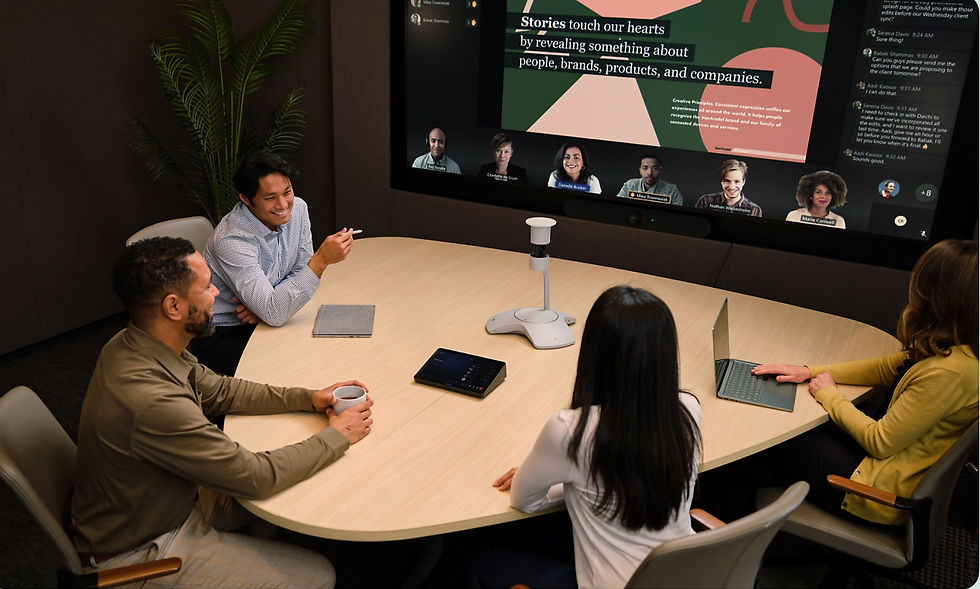
Those sitting around the meeting room table naturally benefit from body language, eye contact and informal conversation. Remote participants often experience a different reality, relying entirely on camera angles, microphone quality and screen layouts to remain engaged.
The result is an imbalance that is rarely intentional but frequently significant.
Employees joining remotely may contribute less often.
Ideas can be overlooked.
Important conversations sometimes happen before or after the official meeting.
Decision-making subtly favours those physically present.
Artificial Intelligence is beginning to play an important role in addressing these challenges.
Speaker tracking, intelligent framing, noise suppression, live transcription, real-time translation and AI-generated meeting summaries all contribute towards creating a more inclusive collaboration experience.
None of these capabilities replaces good leadership or thoughtful meeting design.
But they can help ensure that location becomes less relevant than contribution.
For growing SMEs embracing hybrid working, that represents a meaningful opportunity.
Because attracting talent increasingly depends upon creating workplaces where flexibility does not come at the expense of inclusion.
Technology alone cannot achieve that.
Thoughtful design can.
The Bigger Picture
Perhaps the most revealing aspect of Microsoft's and Zoom's current strategies is not where they differ.
It is where they agree.
Both organisations appear to recognise that the future of workplace collaboration will not be won through increasingly complicated technology.
It will be won through increasingly invisible technology.
The best meeting room of the future may not be the one with the most impressive specification sheet.
It may simply be the room that nobody talks about afterwards.
Because everything just worked.
That may sound like a surprisingly modest ambition.
In reality, it is perhaps the most ambitious objective workplace technology has ever pursued.
After decades of asking people to adapt to technology, the industry is finally beginning to ask how technology can adapt to people instead.
And that changes the conversation entirely.
______________________________________________________
The Third Option Nobody Talks About Enough
By now, you may be expecting us to reach a conclusion.
Perhaps this is the point where we declare Microsoft Teams Rooms the winner. Or perhaps we champion Zoom Rooms as the more flexible alternative.
In reality, neither conclusion would reflect what we are seeing across the organisations we work with.
Because there is another option that is becoming increasingly important, particularly for growing SMEs.
Bring Your Own Device, more commonly known as BYOD.

Not long ago, BYOD meeting rooms were often viewed as a compromise. They lacked the polish of a dedicated room system and were sometimes dismissed as a temporary solution for organisations with limited budgets.
That perception has changed dramatically.
Today, a well-designed BYOD meeting space can provide one of the most flexible and future-ready collaboration environments available.
The principle is refreshingly simple.
Rather than asking employees to adapt to the room, the room adapts to them.
Users enter the space with the laptop they already use every day, connect via a single USB-C cable or wirelessly, launch whichever collaboration platform their meeting requires and immediately gain access to professional cameras, microphones, speakers and displays.
The meeting room becomes platform-independent.
The experience remains consistent.
The technology quietly gets on with its job.
For organisations whose teams spend their days collaborating with multiple customers, suppliers and partners, this flexibility is becoming increasingly valuable.
After all, your next meeting may be hosted on Microsoft Teams.
The one after that could be on Zoom.
Later that afternoon, a customer may send you a Google Meet invitation.
Your meeting room shouldn't force you to think about which platform you're using.
It should simply allow you to collaborate.

Flexibility Is Becoming a Competitive Advantage
This shift reflects a much broader change in the workplace.
For many years, organisations understandably sought standardisation. One platform.
One way of working. One technology ecosystem.
There are still clear benefits to that approach, particularly for organisations heavily invested in Microsoft 365 or Zoom Workplace.
But growing businesses are often more dynamic.
They acquire companies.
They work with external consultants.
They build partnerships.
They serve customers with different technology preferences.
They embrace hybrid working.
In that environment, flexibility becomes just as valuable as standardisation.
Increasingly, we are seeing organisations adopt blended workplace strategies.
Executive boardrooms may be equipped with native Microsoft Teams Rooms because internal collaboration is central to the business.
Customer-facing spaces may prioritise flexibility through BYOD, allowing staff to join any meeting platform with minimal effort.
Huddle rooms may combine native room functionality with USB pass-through, offering the best of both worlds.
Rather than asking every room to perform the same role, organisations are designing spaces around the people who use them.
It is a subtle but important shift in thinking.
The Best Meeting Room Is the One Nobody Notices
One of the recurring themes throughout this article has been friction.
Almost every workplace frustration can be traced back to it.
The meeting starts late because someone cannot connect.
A remote participant struggles to hear the discussion.
The camera points at the wrong person.
Somebody spends the first five minutes searching for the correct cable.
None of these problems are particularly dramatic.
Yet together they shape people's perception of workplace technology.
Ironically, employees rarely praise a meeting room because it has an excellent specification.
They praise it because they didn't have to think about it.
The meeting simply started.
Everyone could participate.
The conversation flowed naturally.
The technology disappeared into the background.
That is where the industry is heading.
Artificial Intelligence.
Platform flexibility.
Intelligent cameras.
Speaker tracking.
Wireless connectivity.
Cloud management.
They are all important developments.
But they are not the destination.
They are simply different ways of achieving the same objective.
Making collaboration feel effortless.
So... Microsoft Teams Rooms or Zoom Rooms?
Having explored both platforms, discussed Artificial Intelligence and considered the growing role of BYOD, it is tempting to return to the question we began with.
Which is better?
The honest answer is that both Microsoft Teams Rooms and Zoom Rooms are exceptional platforms.
If your organisation is deeply invested in Microsoft 365 and wants a highly integrated workplace ecosystem with centralised management, Teams Rooms may be the natural choice.
If your business values simplicity, flexibility and collaborates extensively with organisations already using Zoom, Zoom Rooms may align more closely with your day-to-day needs.
Neither choice is inherently right.
Neither is inherently wrong.
The best decision depends entirely on how your organisation works.
That is why we rarely begin our conversations by discussing platforms.
Instead, we ask about people.
How do your teams collaborate?
Where are meetings taking place?
What frustrations do employees experience today?
How might your business evolve over the next five years?
Those answers invariably shape the technology strategy far more effectively than any feature comparison.

The COLLAB AV Perspective
At COLLAB AV, we have never believed that great collaboration begins with products.
It begins with understanding.
Understanding how your people communicate.
Understanding where hybrid working creates challenges.
Understanding the expectations of customers, partners and employees.
Only then do we begin designing technology that supports those experiences.
Sometimes that leads to Microsoft Teams Rooms.
Sometimes it leads to Zoom Rooms.
Increasingly, it involves thoughtfully designed BYOD spaces or a combination of approaches that provide the flexibility modern businesses need.
There is no universal blueprint because no two organisations collaborate in exactly the same way.
That is why we describe ourselves as a consultancy-led AV and workplace collaboration specialist.
Our role is not to recommend the technology we know best.
Our role is to recommend the technology that will help your people do their best work.
Perhaps that is why we so rarely answer the original question.
Not because it is unimportant.
But because, in our experience, there is a better one.
Not...
"Should we choose Microsoft Teams Rooms or Zoom Rooms?"
But...
"How can we create collaboration spaces that simply work for everyone?"
When organisations start there, the right technology usually becomes obvious.
And that, ultimately, is the conversation worth having.


Comments